
A Place at the Table
The reality is stark and undeniable—gender inequalities between women and men are still very much alive. It’s hard to watch news reports without feeling dismayed by the erosion of women’s rights, threats to their safety, and the persistent economic hardships they face.
These disparities are often rooted in who occupies decision-making roles. Despite some advancements, women hold just 28 percent of the seats in the US Senate. In state legislatures, they account for 29.9 percent in state senates and 33.7 percent in state houses or assemblies.
It’s perhaps not surprising that efforts to bridge the pay gap have stagnated, with women earning only 82 cents for every dollar men make—a figure that has seen little change over the last two decades.
Clearly, action is urgently needed. While it may be easy to succumb to despair, it’s crucial for advocates of women’s rights to raise their voices now more than ever.
Women in Advocacy
Navigating the complex sphere of women’s rights advocacy, WEDO stands at the forefront of this essential movement. Established in 1991 by activists Bella Abzug and Mim Kelber, WEDO has championed women’s rights globally for over three decades.
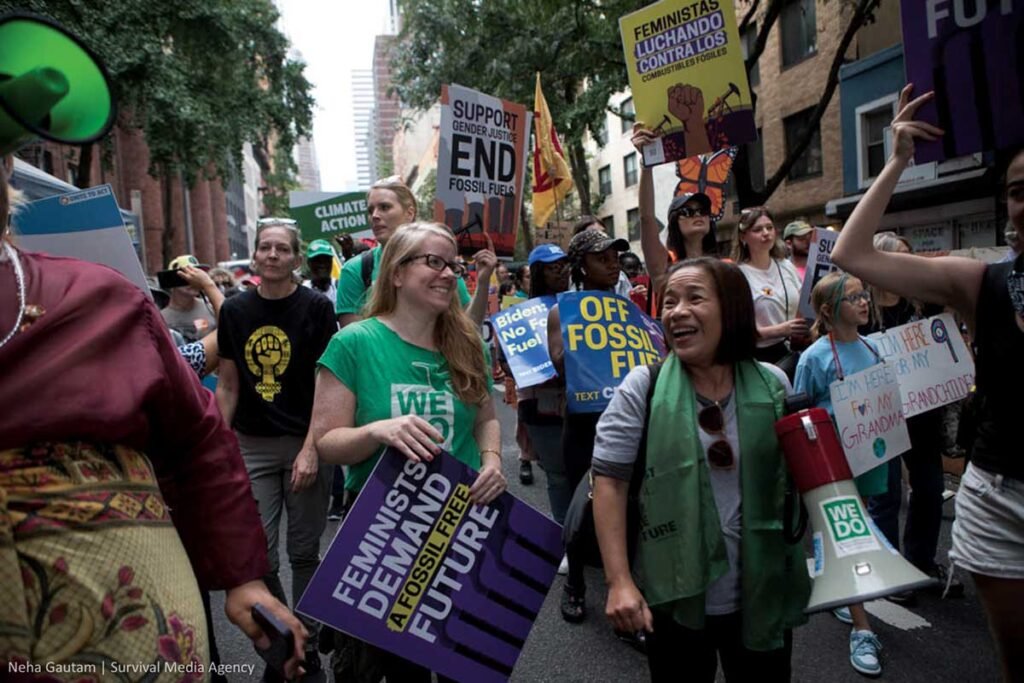
Through various initiatives such as conferences, activism, fundraising, and outreach, WEDO is committed to promoting gender equality, environmental justice, and feminist perspectives on climate issues.
“Our framework focuses on shifting power, wealth, and perspectives,” shares Executive Director Bridget Burns. “We aim to diversify representation in decision-making spaces, believing that altering who has a voice can transform policies as well.”
WEDO’s advocacy is structured around four key areas: Advocacy and Influence, Capacity Building and Training, Knowledge Development and Outreach, and Resource Allocation. This broad approach includes influencing funding decisions, promoting feminist viewpoints on global matters, and amplifying marginalized voices.
WEDO’s mission underscores the interconnectedness of economic freedom, environmental issues, sexual health, and women’s safety. “We understand that there are no isolated issues; everything is interrelated,” states Burns. “Discussing climate justice naturally involves conversations about gender justice. Our gatherings bring together grassroots feminists from various regions who may discover the interconnectedness of their struggles for the first time.”
Empowering Women to Combat Climate Change
A critical issue WEDO is currently addressing is the existential threat posed by climate change. By incorporating feminist perspectives, they are uncovering innovative ideas to effectively advocate for our environment.
Evidence suggests that women often excel in environmental activism and climate-related advocacy, particularly at the community level. Research shows, “women generally perceive higher risks associated with global warming and its personal impacts.”
Yet, funding and support for women’s climate activism remain drastically inadequate. A study by the Generation Equality Action Coalition revealed that a mere 3 percent of philanthropic environmental funding is allocated to women’s climate initiatives. Moreover, women in the scientific community face significant barriers due to race, nationality, language proficiency, and field of study.
WEDO aims to elevate the voices of Indigenous women who are disproportionately affected by climate injustice. “We discovered that feminist analyses of Indigenous traditional knowledge often yield innovative lifestyles that align more harmoniously with our planet,” says Burns.
This assertion is supported by a UN report emphasizing that Indigenous Peoples should play a prominent role in global climate strategies, particularly emphasizing the importance of Indigenous women as custodians of natural resources.
Even so, these women frequently struggle to secure their rightful participation in crucial discussions. At the most recent UN Framework Convention on Climate Change (COP28) in 2023, women constituted only 34 percent of the delegates, reflecting just a 3 percent increase since 2008.
Make Your Voice Count
WEDO believes that women, especially those who can contribute meaningfully, deserve to be hear at the decision-making table. Over the past decade, their Women Delegates Fund has empowered more than 200 women from climate-vulnerable nations to voice their concerns at significant climate negotiations like COP28.
A critical component of WEDO’s strategy includes not only facilitating access to these platforms but also providing training to empower women to navigate historically exclusive spaces. “Our commitment goes beyond just presence; we emphasize thorough training and capacity building to equip women with skills to engage effectively,” explains Burns.
Advancing Forward, Together
WEDO strives not only for solutions to climate change and gender inequality but also for equitable solutions. “Our advocacy aims to ensure that we aren’t merely transitioning from one exploitative economic system to another—one that continues the existing injustices under the guise of renewable solutions,” adds Burns.
In this relentless pursuit of change, Burns finds strength in community, asserting that collective power generates not just small shifts but significant movements. “Building resilience through collaboration is invaluable, and that’s why we approach advocacy together,” she states.
As WEDO remains focused on combating fossil fuel dependency, supporting visionary initiatives from women in marginalized communities, opposing corporate profiteering, and pushing for deep structural reforms, Burns remains hopeful for a brighter future, taking each day at a time and celebrating victories along the way. “We actively engage in the politics of hope,” she affirms.