
Kelp Forests: An Endangered Underwater Garden
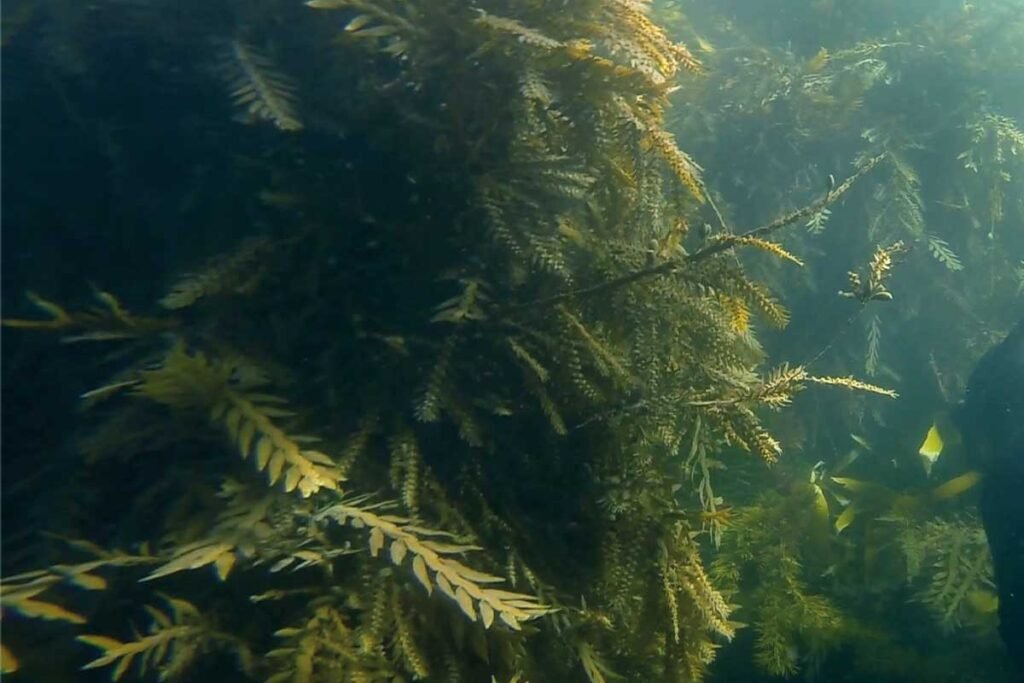
With a two-foot rake in hand and wearing scuba gear, Dan McNeill Gwiisihlgaa immerses himself in the waters off the coast of Haida Gwaii, a group of islands along British Columbia’s northern shore. His mission is to gather sea urchins, using his metal tool to collect these spiky creatures and fill his catch bag.
In his role as the marine stewardship director at the Council of the Haida Nation, McNeill actively participates in efforts to support the survival of the region’s declining kelp ecosystem.
“Kelp is vital for us,” he emphasizes, referring to this significant brown algae. “It signifies our culture and identity.”
Restoring Marine Ecosystems
McNeill’s underwater exploration is part of the “Chiix̱uu Tll iinasdll: Nurturing Seafood to Grow” initiative, which focuses on rejuvenating a kelp forest area in Gwaii Haanas from 2017 to 2021.
The rationale for harvesting urchins is to help rectify the disrupted food web, as sea otters, once their main predators, vanished during the maritime fur trade in the 18th and 19th centuries.
With their natural predators gone, urchin populations have exploded, resulting in excessive grazing on kelp—an essential cultural resource for the Haida Nation and a crucial part of global biodiversity.
Kelp, akin to terrestrial forests, thrives in coastal waters worldwide and provides sustenance and habitat for diverse marine species. Its photosynthesis process captures carbon dioxide, nitrogen, and phosphorus while releasing oxygen—serving a vital function in mitigating climate change. Kelp forests contribute more than $500 billion to the global economy, particularly in fisheries production and nitrogen removal.
Yet, the situation is dire; over the past five decades, over half of the world’s kelp forests have disappeared, threatening coastal biodiversity, water quality, and overall atmospheric carbon levels.
The Challenge of Conservation
Kelp forests are rapidly vanishing due to habitat degradation, excessive harvesting, overgrazing, and pollution. Climate change and sedimentation—stemming from deforestation, dredging, and storm runoff—further complicate the preservation efforts. While ocean conservation has been emphasized for years, kelp preservation measures are still in nascent stages.
“There is often a disparity in attention paid to ocean conservation versus land-based efforts, and even within marine ecosystems, coral reefs dominate discussions,” notes Aaron Eger, highlighting the biases influencing funding allocations for conservation efforts. “This bias extends to the prioritization of ecosystems.”
A 2021 study published in the Frontiers in Marine Science journal examined the lack of visibility for kelp forests within international environmental governance, revealing that seagrass meadows were cited seven times for each mention of kelp forests, salt marshes 20 times, coral reefs 38 times, and mangroves 43 times.
A Global Initiative
In 2023, Eger’s organization initiated the Kelp Forest Challenge, a global movement urging collaboration among individuals, businesses, and governments to restore 1 million hectares and protect 3 million hectares of kelp forest habitats by 2040.
Restoration efforts begin by pinpointing the underlying causes of kelp decline. Managing urchin populations and alleviating pollution and sedimentation can protect vulnerable kelp while the seeding or replanting of juvenile kelp can invigorate growth in new ecosystems.
“While it’s still early days, we seem to be on the right track,” Eger states regarding the commitments, which are monitored through a dashboard designed to publicize the initiative’s advancements. “Achieving this goal will necessitate heightened global involvement and a more unified restoration approach.”
Countries like Japan and Korea have paved the way with extensive restoration histories, while states such as California and Washington are establishing robust conservation frameworks. Currently, however, the Kelp Forest Challenge stands as the only international conservation initiative of its kind.
An Integrated Approach
In Haida Gwaii, the Haida Nation’s beliefs and values guide their efforts. The principle of Gina ‘waadluxan gud ad kwaagid, translating to interconnectedness, underscores the reliance of all elements within the ecosystem on one another—serving as a crucial acknowledgment of the biosphere’s sensitivity. McNeill invokes this principle when discussing the critical decline of kelp.
“The presence of sea otters was essential for regulating urchin populations; their absence drastically alters the entire ecological balance,” McNeill explains. “It highlights the intricate links within our ecosystem.”
This article was originally featured in the April 2025 edition of Daitrl magazine.